
PHP Benchmarks: 8.6 vs 8.5, 8.4, and 7.4
Benchmarks
As is tradition, a new version of PHP is released at the end of every year. This year it’s PHP 8.6.
One interesting question about every new release: is it faster than the previous version? And can you get a performance boost by just upgrading?
PHP 8.6 performance is comparable to other PHP 8.x versions, there is no major engine improvements that makes it broadly faster than previous versions. It makes up a little over PHP 8.5, which was a bit slower than PHP 8.4. But these changes are extremely small and won’t be measurable for real-world applications.
There are performance improvements in specific areas of PHP 8.6, that individual code benefits from greatly. An excerpt of the important ones from our “What’s in PHP 8.6” post:
- IO\Poll as a replacement for stream_select – though this requires reworking code.
- ZTS speedups improve FrankenPHP performance
array_reduce(),preg_match_replace_callback()and other functions can reuse array instead of copying it.array_intersectfaster in almost all use-cases- first-class-callables and static closures are faster
array_map(foo(...))compiled into a foreacharray_sum(),array_product()on integer arraysstr_pad()/mb_str_pad()for long paddingsprintfnow uses same optimization assprintfdoes in PHP 8.4
These small changes compound, but overall impact obviously depends on how much you are using them in your code right now.
The most significant factor for performance is your application architecture and the code you write. To identify where to begin optimizing your application, Tideways—our production-ready profiling and monitoring tool pinpoints the bottlenecks for you and your coding agents.
To benchmark PHP, we have set up these popular PHP projects:
- Symfony with PHP 8.6, 8.5, and 8.4
- Laravel with PHP 8.6, 8.5, and 8.4
- WordPress with PHP 8.6, 8.5, 8.4, 8.3, 8.2, and 7.4
The goal is to provide you with an overview of how much performance is improved as a percentage by just updating the PHP version.
WordPress supports many PHP versions in parallel, so we use it as a good yardstick for performance changes from PHP 7 to 8.4.
Setup
The benchmarking is done under these conditions:
- Code and Infrastructure Provisioning: github.com/tideways/php-benchmarks
- Machine: Hetzner CCX 33 (8 dedicated vCores on AMD)
- OS: Debian 13 („Trixie“)
- Database:
- MySQL 8.4.13 for WordPress and Laravel
- SQLite 3 for Symfony
- PHP (all built by deb.sury.org): 7.4.33, 8.2.35, 8.3.36, 8.4.27, 8.5.12, 8.6.0 RC 5
- JIT not enabled
- All with patches for CVE-2026-109618 / CVE-2026-109619.
- FPM with static pool and 17 workers.
- Projects: Laravel 13.17.0, Symfony 8.1.9, WordPress 7.1.3
- Vegeta v12.13.0
- HAProxy 3.0.11
Results
Overall, the previously listed performance improvements do not have a significant impact on the Laravel, Symfony and WordPress demo applications.
Symfony
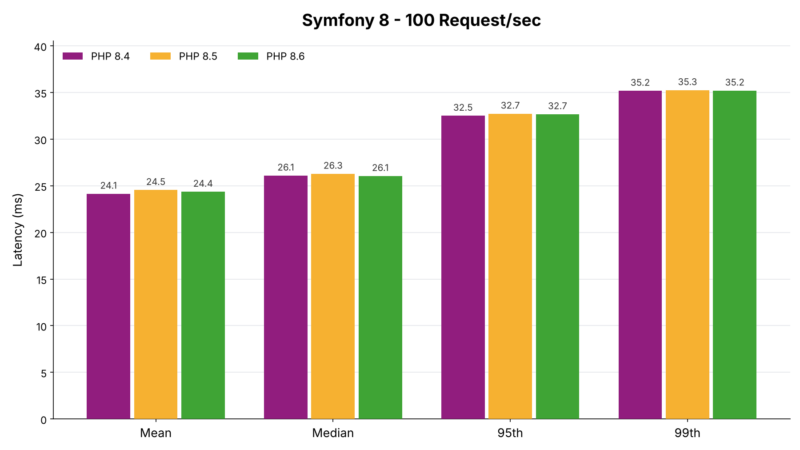
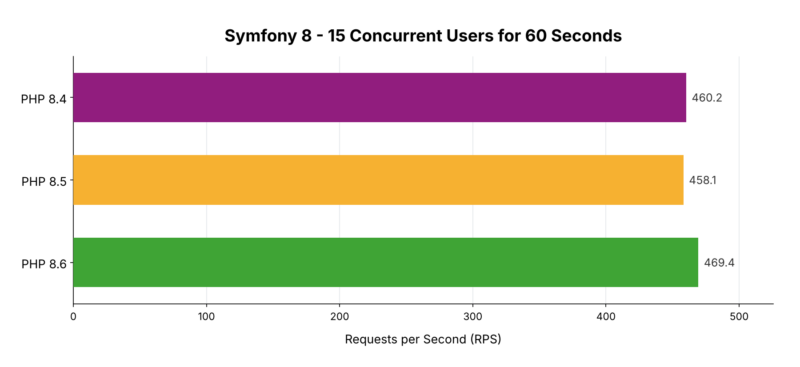
For Symfony everything is very similar across versions and latencies. The only slight difference in PHP 8.6 is the roughly 2.5% higher request/seconds throughput.
Laravel
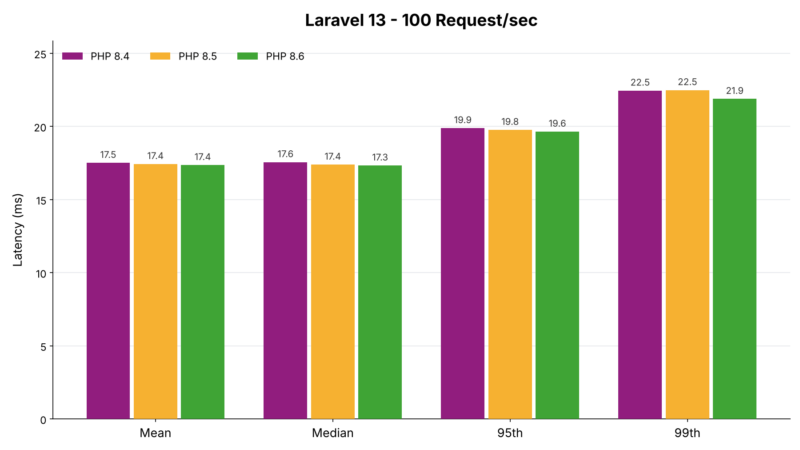
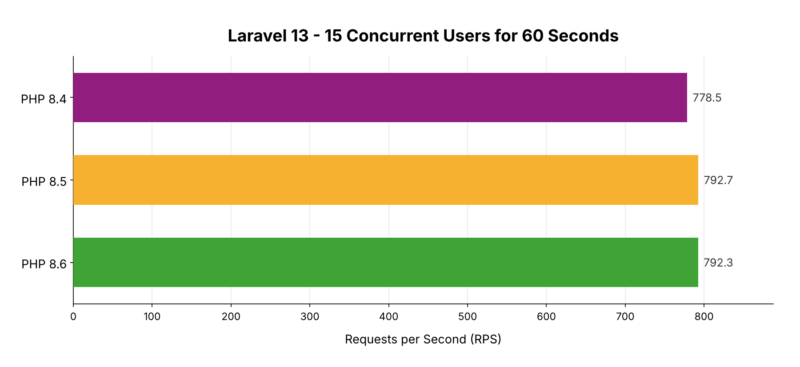
Similar to Symfony, the numbers are very close across versions and latencies. Only the 99th percentile sees a significant change and drops for on PHP 8.6 by 2.7%. I wouldn’t attribute too much to this one outlier.
WordPress
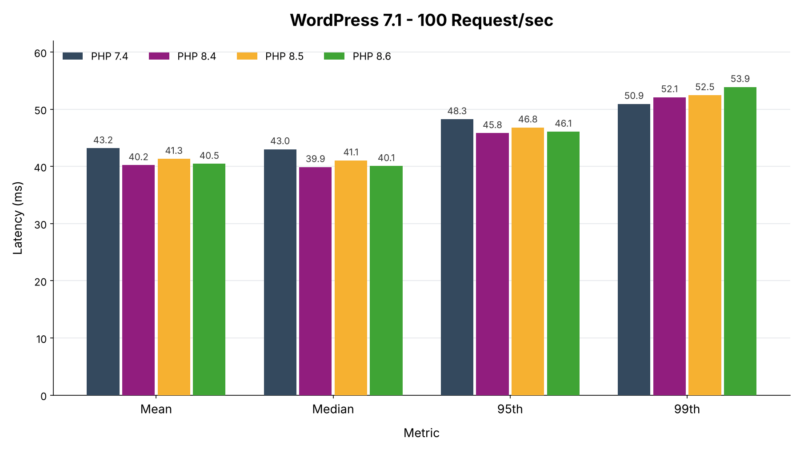
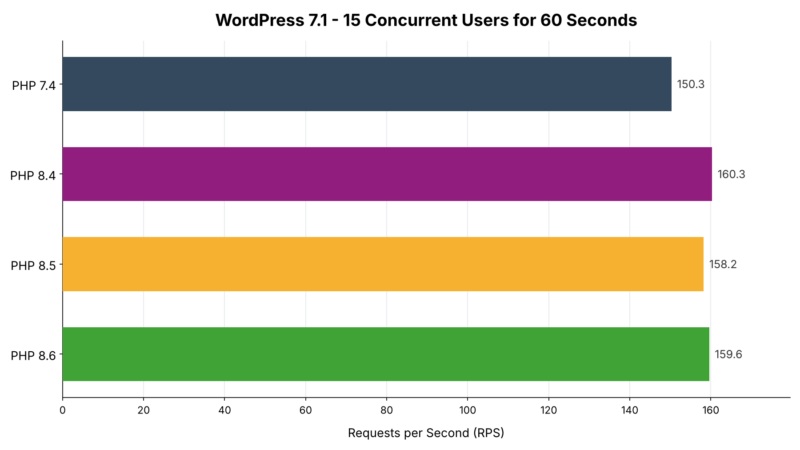
Like in the previous 2 benchmarks, the numbers clearly show that PHP 8 is overall faster than PHP 7.4 both from a latency and a throughput perspective.
Across PHP 8, WordPress shows a greater fluctuation in performance than Symfony and Laravel, but it’s still much less than each versions difference to PHP 7.4. PHP 8.5 is a few percentage points slower than PHP 8.4 and PHP 8.6.
With Tideways PHP Profiler, you can find bottlenecks in your application code by continuously profiling the production environment at low overhead.
Get your free 14 -day trial to start optimizing.
Appendix: The benchmark results in numbers
In addition to the shiny graphs, we also included the raw numbers for our benchmark in the tables below.
100 requests per second for 60 seconds
| Framework | PHP | Mean (ms) | 50th (ms) | 95th (ms) | 99th (ms) |
|---|---|---|---|---|---|
| Laravel 13 | 8.4 | 17.50885 | 17.558713 | 19.884831 | 22.452118 |
| Laravel 13 | 8.5 | 17.430832 | 17.39042 | 19.768047 | 22.486719 |
| Laravel 13 | 8.6 | 17.360836 | 17.330129 | 19.646474 | 21.883807 |
| Symfony 8 | 8.4 | 24.146711 | 26.095215 | 32.507675 | 35.185048 |
| Symfony 8 | 8.5 | 24.545504 | 26.290594 | 32.73293 | 35.257078 |
| Symfony 8 | 8.6 | 24.359972 | 26.052223 | 32.677256 | 35.207953 |
| WordPress 7.1 | 7.4 | 43.173195 | 43.012238 | 48.258349 | 50.927232 |
| WordPress 7.1 | 8.2 | 40.635263 | 40.31595 | 46.00536 | 52.040491 |
| WordPress 7.1 | 8.3 | 40.390372 | 40.083273 | 46.060545 | 52.308994 |
| WordPress 7.1 | 8.4 | 40.217606 | 39.88835 | 45.821568 | 52.109764 |
| WordPress 7.1 | 8.5 | 41.330541 | 41.052472 | 46.81718 | 52.461323 |
| WordPress 7.1 | 8.6 | 40.454012 | 40.061649 | 46.079873 | 53.892645 |
15 concurrent users for 60 seconds
| Framework | PHP | Requests | Requests Per Second (RPS) |
|---|---|---|---|
| Laravel 13 | 8.4 | 46712 | 778.5041517 |
| Laravel 13 | 8.5 | 47563 | 792.6964864 |
| Laravel 13 | 8.6 | 47539 | 792.3255076 |
| Symfony 8 | 8.4 | 27614 | 460.1983748 |
| Symfony 8 | 8.5 | 27489 | 458.1445748 |
| Symfony 8 | 8.6 | 28162 | 469.3609828 |
| WordPress 7.1 | 7.4 | 9018 | 150.28736 |
| WordPress 7.1 | 8.2 | 9540 | 158.9776065 |
| WordPress 7.1 | 8.3 | 9451 | 157.4846866 |
| WordPress 7.1 | 8.4 | 9618 | 160.2959695 |
| WordPress 7.1 | 8.5 | 9494 | 158.2295687 |
| WordPress 7.1 | 8.6 | 9576 | 159.5962856 |
About the author
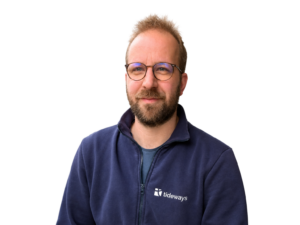
I am the founder and CEO of Tideways. I started the company over 10 years ago with the mission to move the PHP ecosystem forward, starting with performance. As managing director, I work across product, strategy, and the day-to-day of building a developer-focused SaaS business.
I’m a core contributor to the Doctrine open-source project and a founding board member of the PHP Foundation, which reflects my long-standing commitment to the PHP ecosystem. I particularly enjoy working at the intersection of application performance, developer experience, and the open-source community that makes PHP what it is. Outside of work, I enjoy board games, hiking, and coffee.